Mirror: A career coaching tool for product designers
AI CASE STUDY
PSYCHOLOGY
(an afternoon project)
The industry is loud right now
Every week there is a new tool to test. A new AI feature to evaluate. A new workflow to adopt. The pace is not slowing down and for product designers, the pressure is compounding. Roles are blurring.
Am I developing in the right direction? Is this skill worth pursuing? More tools, more opinions, more comparison, and less clarity about what actually matters for you.
Popular apps in 2026
The starting point
As a designer navigating a job search, the most meaningful way I found to adapt was offloading thoughts and reflections into Claude after significant moments: interviews, friction and feedback. I used these conversations to uncover trends I couldn't see from inside the experience.
Not asking for advice. Thinking out loud, and finding that articulating something revealed patterns I'd been too close to notice. That a particular kind of stakeholder conversation kept appearing as friction.
"Mirror" is the designed version of something I was already doing imperfectly with Claude.
What already exists (and why it's not enough)
The market has tools like resume optimisers, job trackers and AI interview coaches. Most are built for one scenario: you're looking for a job, here's how to find one faster. Nobody does mid-career navigation well.
The access problem is real. I've paid for mentorship myself, around $200 per month for a single session. Appraisals have been scarce. They're both valuable when it works, but expensive, infrequent, and the insight lives in the session. It doesn't accumulate.
The psychology underneath
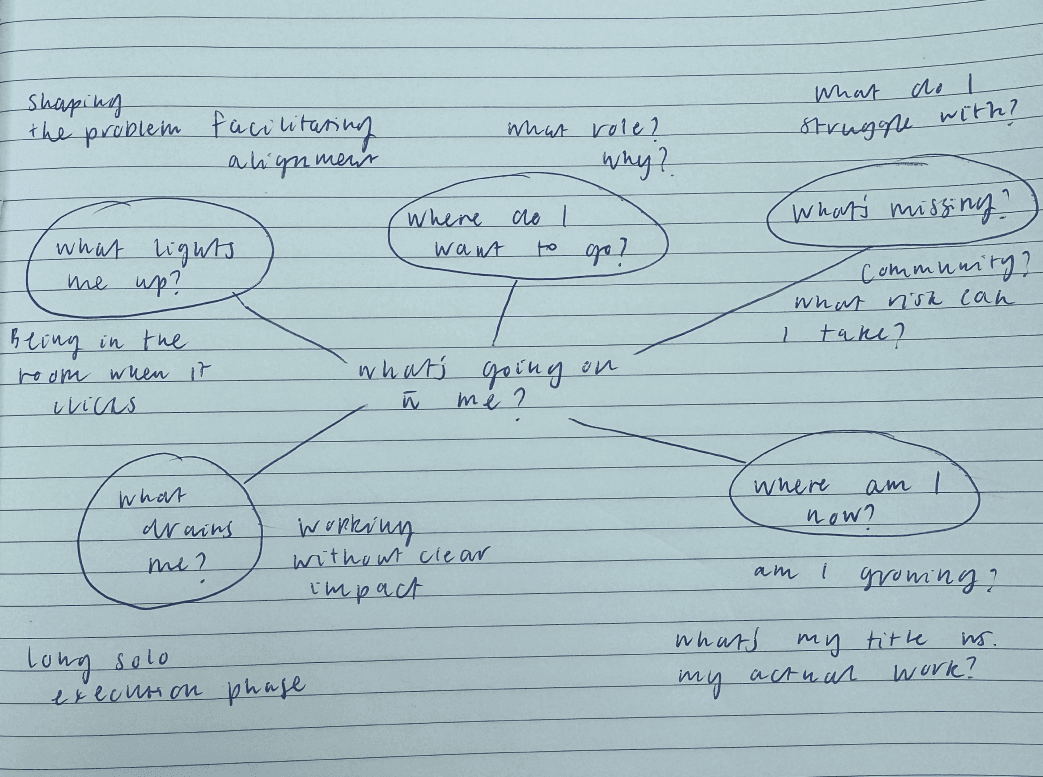
My moment of self reflection…
Two frameworks shaped the design: self-efficacy and metacognition.
Self-efficacy, (Bandura's concept) is belief in your own capacity to succeed in a specific situation, built from evidence. For designers in a noisy industry, it erodes when you can't see your own progress clearly. The LinkedIn doom scroll activates a gap without giving you tools to close it.
Metacognition is thinking about your own thinking. It's about monitoring performance, noticing where you're stuck and adjusting your approach. It separates people who learn from experience from people who just accumulate it.
The implication is this tool shouldn't measure you. It should help you see your own patterns, and build the evidence base that makes self-efficacy possible.
The flow

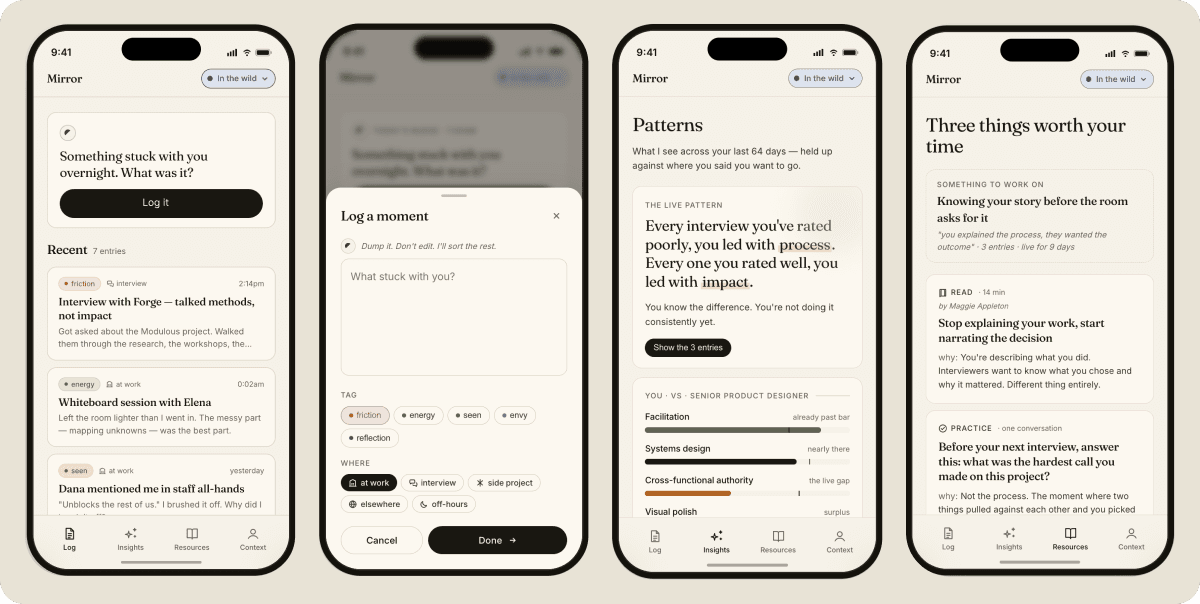
By collabing with Claude & Figma Make, I had three key requirements in mind: make the first action easy (a dump), behave like a journal (that can speak back), summarise findings (trends to highlight opportunities to do better).
01 Entry: landing, CV drop, reading state. Three quick screens, minimal friction to get in.
02 Reframe: the mirror moment. Opinionated, named, reactionable.
03 Mode: pick where you are, see it immediately reflected in the context panel as a changeable dropdown.
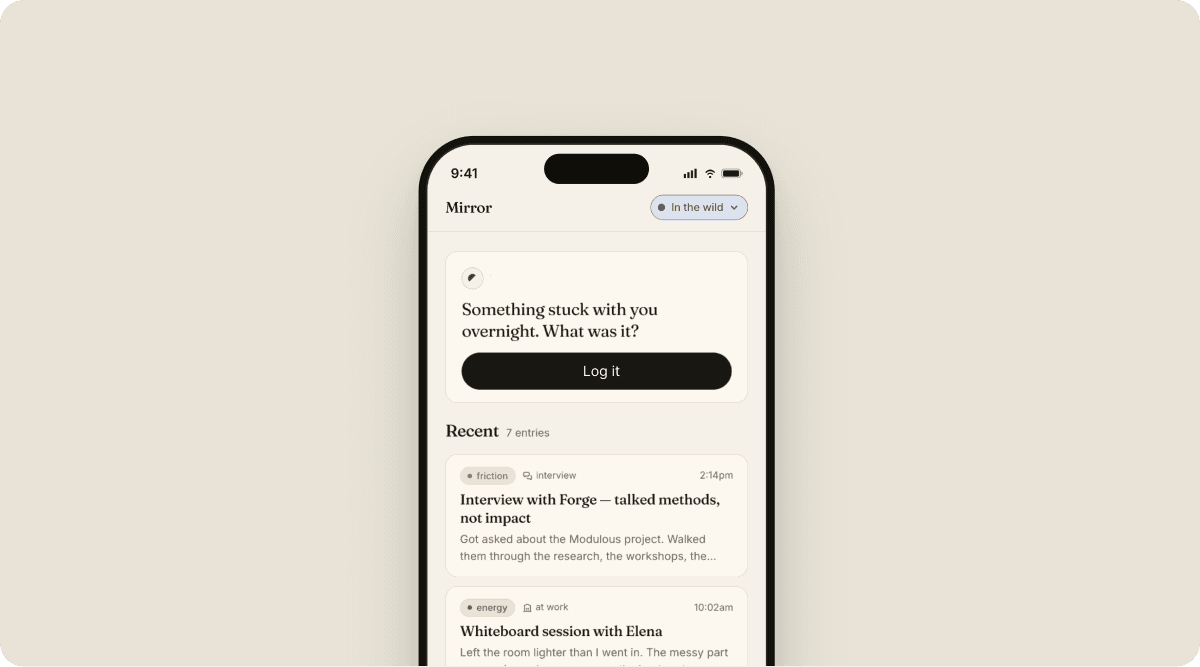
04 Log: the core ongoing behaviour. Tag loosely, dump honestly, move on. Recent entries visible immediately below.
05 Insights: patterns the app surfaces from accumulated logs, mapped against the target role.
06 Resources: three things, with a reason, attached to a specific gap. Not a library.
The loop: at the bottom ties it together. Something happens, log it, pattern surfaces, gap named, resource attached, next experience is sharper.
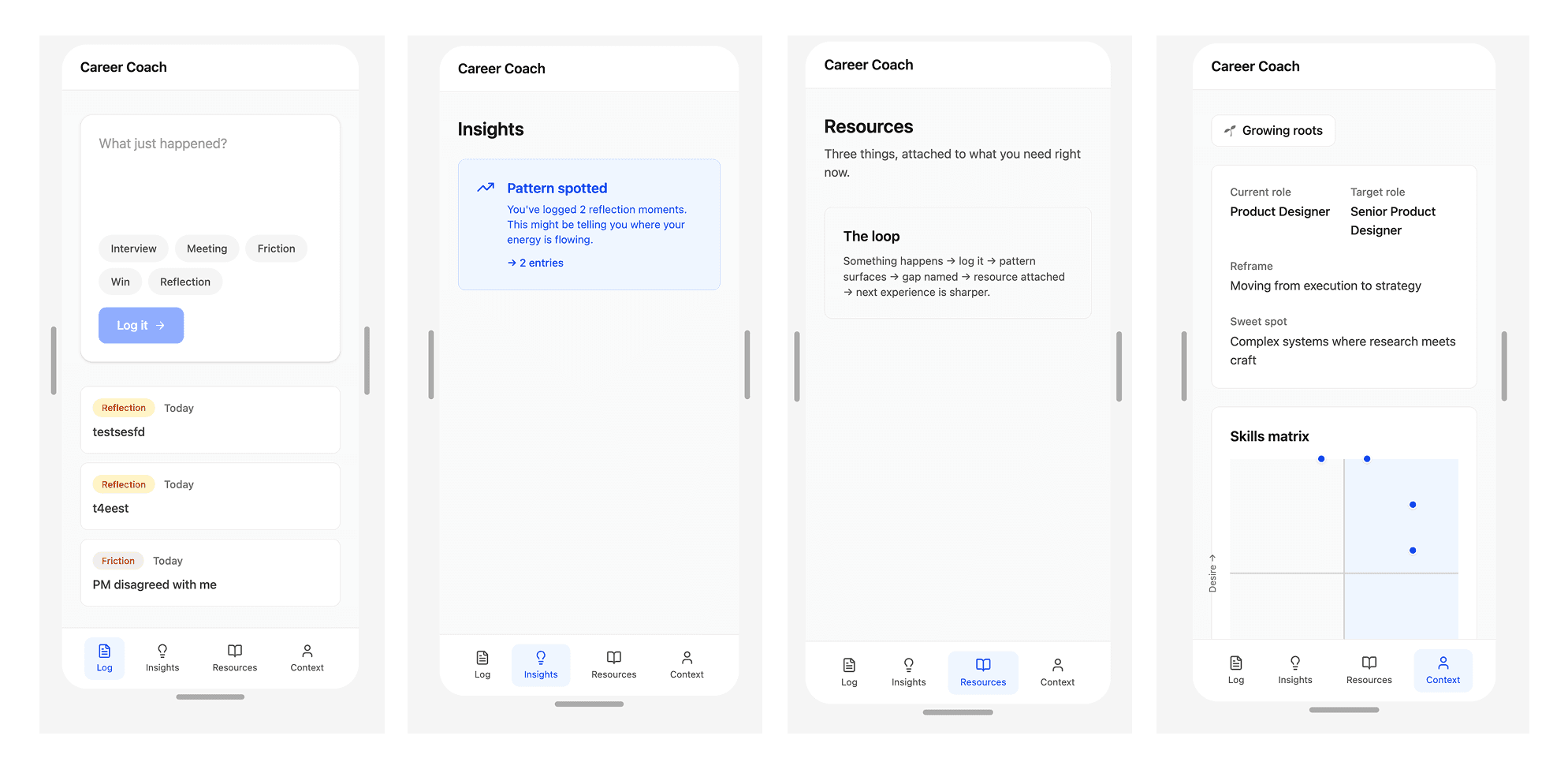
Dumping initial thoughts in Figma Make
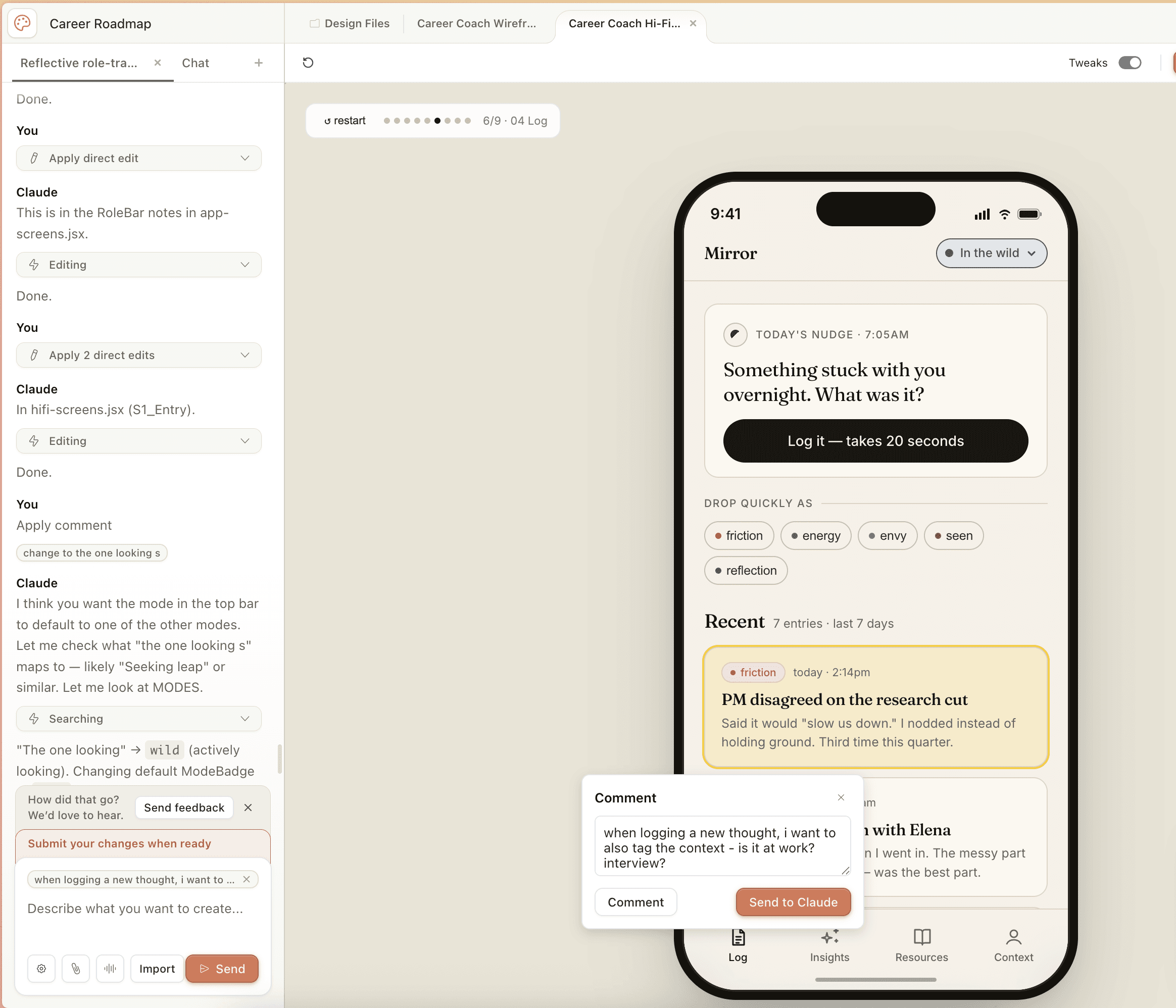
Claude Design iterations
Onboarding
[user] Dump CV
[mirror] ingests and interprets
[user] classify status
Core Flow
[user] something happens, logs moments
[mirror] pattern surfaces
[mirror] gap named
[user] review resources
[user] sharpens, better articulates what and how they can level up
What's next?
Testing. I ran out of Claude credits :( Putting it in the hands of friends to validate value, moments of friction and how to broaden the scope of this living career roadmap!